📦 Who Verifies the Verifier? You Do, Down to the Foundation
📅 Wednesday, Nov 25, 2026
⏰ 9:00 AM
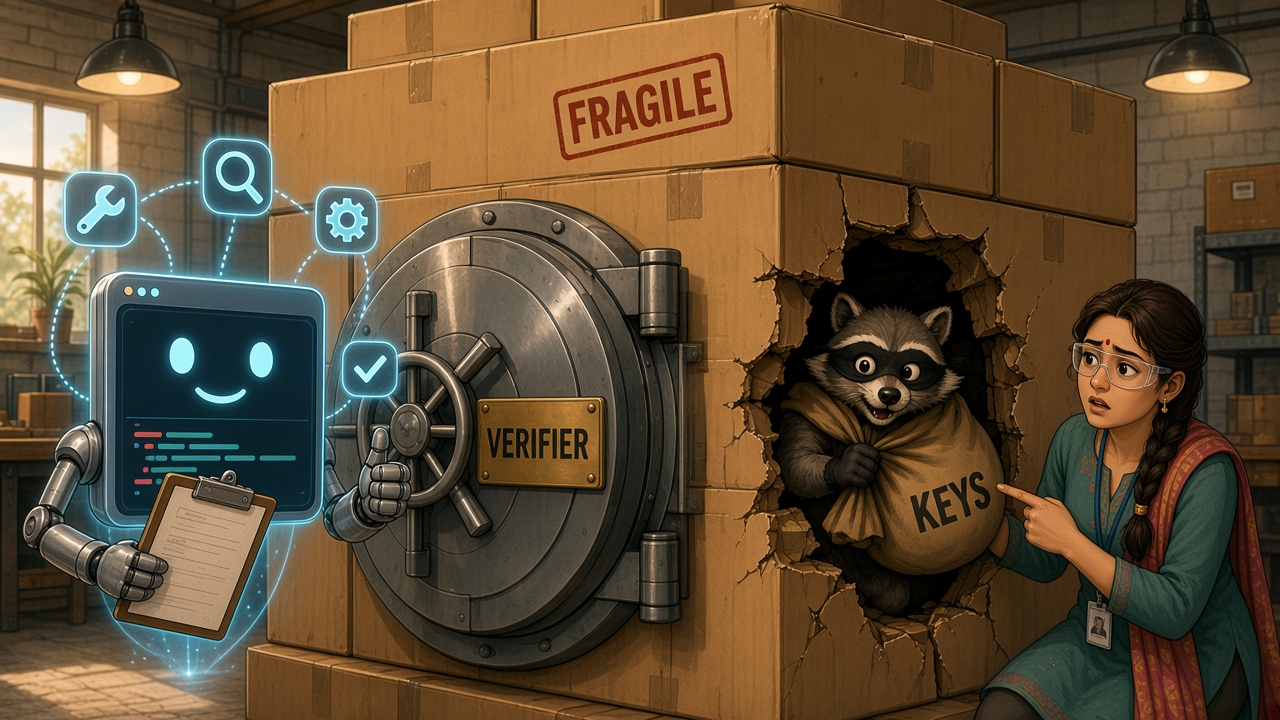
Before you give an AI reviewer authority to approve a change, verify the software it runs on: the framework, its dependencies, the pipeline that released it, and what it’s allowed to touch. Evals grade the reviewer’s answers; they don’t look at that layer. Three incidents from the past year (one of them in my own preferred stack) broke right there.
We talk about the model, the prompt, the review agent, and the agent that checks the review agent. I want to start underneath all of them. What framework executes those decisions, and what dependencies does it load? Who controls its releases? What happens when that foundation fails?
A vault door doesn’t secure a cardboard house.
An impressive AI reviewer can sit on top of unsafe deserialization, excessive permissions, or a compromised dependency. How well it finds bugs in your code tells you very little about whether its own runtime deserves your trust.
The evaluator was part of the attack surface
The model’s judgment can vary. The code around it still has to enforce permissions, preserve state, and report what actually ran (I made that case in The Runtime Is the Product ), and as we add autonomy, I want that surrounding system to get more predictable and easier to inspect. The quality of the judgment and the integrity of the machinery delivering it both need evidence. Evals cover the first, and every handoff in the software factory needs them . The second is where the past year’s incidents happened.
In December 2025, LangChain disclosed CVE-2025-68664
, a critical serialization injection flaw in langchain-core. Its dumps() and dumpd() didn’t escape user-controlled dictionaries containing lc, the key LangChain uses to mark its own objects, so plain data could be serialized and later loaded back as a LangChain object. Under affected conditions, that let an attacker pull secrets out of environment variables or instantiate allowed classes with arguments of their choosing. Fixes shipped in 1.2.5 and 0.3.81.
Two details stand out in a post about verifiers. LangChain’s affected-use list included StringRunEvaluatorChain on untrusted runs, so an evaluation path was itself part of the attack surface. And the advisory names the most common attack vector: LLM response fields like additional_kwargs, which prompt injection can control. A code reviewer reads untrusted text all day (every pull request from outside the team is input an attacker gets to write). Exposure depended on which APIs and data paths a project used, so not every LangChain project was exploitable.
My architectural conclusion is straightforward: testing whether an evaluator gives good answers tells you nothing about whether its input handling is safe.
A valid signature on a poisoned release
On October 21, LiteLLM’s release pipeline published version 1.107.0 to PyPI and its public container registries with compiled malware inside, a credential stealer that also loaded remote-code execution tools. LiteLLM sits between your code and the model providers it calls. The PyPI release was live for about two hours, and LiteLLM told anyone who’d installed it on a host with internet access to assume the secrets were gone and rotate everything that host could reach.
Its root-cause account , published two days later, corrected the first one. An administrative key to an internal agent platform had been committed to a public repository in May and never revoked. That platform runs cloud agents that file pull requests, and someone had configured it with the GitHub CLI token of an organization owner, a token that isn’t scoped to particular repositories. On October 10, the attacker used the key to read that token out of the platform’s API, then ran throwaway CI workflows that stole two maintainers’ tokens.
On October 21 at 10:08:29 UTC, branch protection rejected the attacker’s change to the release workflow. Five seconds later, the owner’s token pushed it anyway. That change let the workflow build from a lookalike fork (Berri-AI/litellm, one hyphen away from BerriAI/litellm), and a second stolen identity approved the release. That week LiteLLM had relaxed its release rule so any two engineers could trigger and approve a release; normally the approval came from an account locked to a device in its office.
LiteLLM had already hardened this pipeline after a compromise in March, with a private release repository, trusted publishing, immutable image tags, and signed images. The poisoned images carried a valid signature from LiteLLM’s real key, because LiteLLM’s own pipeline signed them.
For me, that’s a direct challenge to how we evaluate a platform. A release approval is only as good as the identities and permissions behind it, and a signature tells you which key signed without telling you what the signing process was allowed to build. SLSA’s advice on verifying artifacts
names this attack: compare provenance against the package’s canonical source repository “to prevent an adversary from building from an unofficial fork,” and fail on any build parameter you don’t recognize. The attacker’s commit added one, a source_owner input. Those checks need a build that records its inputs and someone who actually compares them, and SLSA says so itself: “provenance doesn’t do anything unless somebody inspects it.”
My preferred stack gets the same scrutiny
For enterprise work, I give a lot of weight to how long a framework has been around and how long it’ll be supported, and to how well it fits controls the team already knows how to run. Spring Framework 1.0 shipped on March 24, 2004, and LangChain and LangGraph reached 1.0 on October 22, 2025. Spring’s core has more than two decades behind it; LangChain’s promise of no breaking changes before 2.0 is about a year old.
But Spring AI 1.0 arrived on May 20, 2025, five months ahead of LangChain 1.0. Spring Framework’s age doesn’t give a newer AI library twenty years of production history. Each layer needs its own assessment.
On November 19, 2026, Spring disclosed CVE-2026-59344 in Spring AI’s Coherence vector store. Its filter converter built lookups straight from quoted keys in Spring AI’s filter language, and Coherence reads some key strings as actions on the metadata object itself, so a filter could match documents it was never meant to match. On affected versions, code that passes externally influenced or model-generated filter expressions to a Coherence-backed store is exposed, and an attacker who controls one of them could get around tenant or document-scoping filters. That’s an authorization boundary underneath an AI workflow. The Spring name doesn’t verify it.
Its fix table is a support policy in miniature. Open-source users get the fix in 2.0.3, while the fixes for the 1.0 and 1.1 lines ship to enterprise support customers only. Spring maps each project’s support dates to the Spring Boot version it depends on, and the last Spring Boot minor of each major line gets five extra years of enterprise support. LangChain now follows semantic versioning and publishes a long-term support policy for its 1.0 line, and its 0.3 line (the one that got the 0.3.81 fix) gets security patches only until December 2026. A serious comparison checks both policies for every package you deploy.
These incidents expose different failure modes: unsafe handling of data, compromised release authority, and a filter that could be bypassed. I’d treat them as reasons to inspect those boundaries in our own systems. They don’t rank programming languages or frameworks for security, and raw CVE counts wouldn’t either.
Provenance and vulnerability scans answer different questions
SLSA addresses software supply-chain integrity. Its Build track tops out at Level 3, hardened builds. The old Level 4 came from SLSA v0.1 and was deferred when SLSA 1.0 shipped . SLSA 1.2 added a Source track , and its Level 4 means two trusted people review every change to a protected branch (LiteLLM’s release repository required that kind of review, and an owner’s token overrode it). Neither Level 4 has anything to do with CVEs. If someone tells you a verifier is “L4 CVE verified,” ask which L4 they mean and which CVEs were checked.
Provenance records where an artifact came from and how it was built. Vulnerability assessment looks for weaknesses in that software. We need both, and the provenance checker’s own trust settings (which builders it trusts, and up to what level) belong in the review too.
What I’d ask to see before a verifier gets authority
So what would convince me to trust a verifier? I’d start with evidence like this:
| What I want to verify | Evidence I’d ask to inspect |
|---|---|
| The software actually deployed | An SBOM or dependency inventory with resolved versions, plus a current vulnerability assessment |
| The release path | Artifact digest, signatures and provenance checked against the expected source and builder, and who holds release authority |
| The input boundaries | Tests with malicious documents, serialized objects, and model-generated parameters |
| The execution permissions | Scoped service identities, isolated workers, and enforced access limits |
| The verification workflow | Results tied to the reviewed revision, tests for missing or failed checks, and controlled approval permissions |
| Behavior under load | Tail latency, memory under concurrency, bounded retries, cancellation, and recovery after a worker dies, measured apart from model latency on the workload you plan to run |
| The maintenance plan | Support dates for each package, patch ownership, an upgrade process, and recovery procedures |
A demo that handles one request tells me little about a review service working through a queue during an outage.
Those are the acceptance criteria I’d take into a platform review. NIST’s Secure Software Development Framework gives them a footing: PS.2.1 covers release-integrity information, PW.4.4 covers checking third-party components throughout their life cycles, and RV.1 covers finding vulnerabilities on an ongoing basis. The framework, model gateway, evaluator, and their dependencies all belong in that review.
I’d also keep the agent’s authority narrow. LangChain’s own security policy recommends limited permissions and layered defenses, and one line in it describes what happened to the LiteLLM agent platform’s token: “Always assume that any system access or credentials may be used in any way allowed by the permissions they are assigned.” Give the model access to the operations the application can safely permit, and enforce those limits in the systems receiving the requests.
Adding another reviewer gives you another judgment. It can’t repair a compromised package or an access-control flaw underneath both reviewers. Deterministic code has defects too, so those controls need their own testing and review.
Before I let an AI reviewer approve a change, I want to know which version is running, how it arrived, what it can access, and what evidence its decision leaves behind.
Who verifies the verifier? The team giving it authority has to own that answer, all the way down to the foundation.