👑 Data Is King. AI Just Removed the Middleman.
📅 Tuesday, Aug 18, 2026
⏰ 8:00 AM
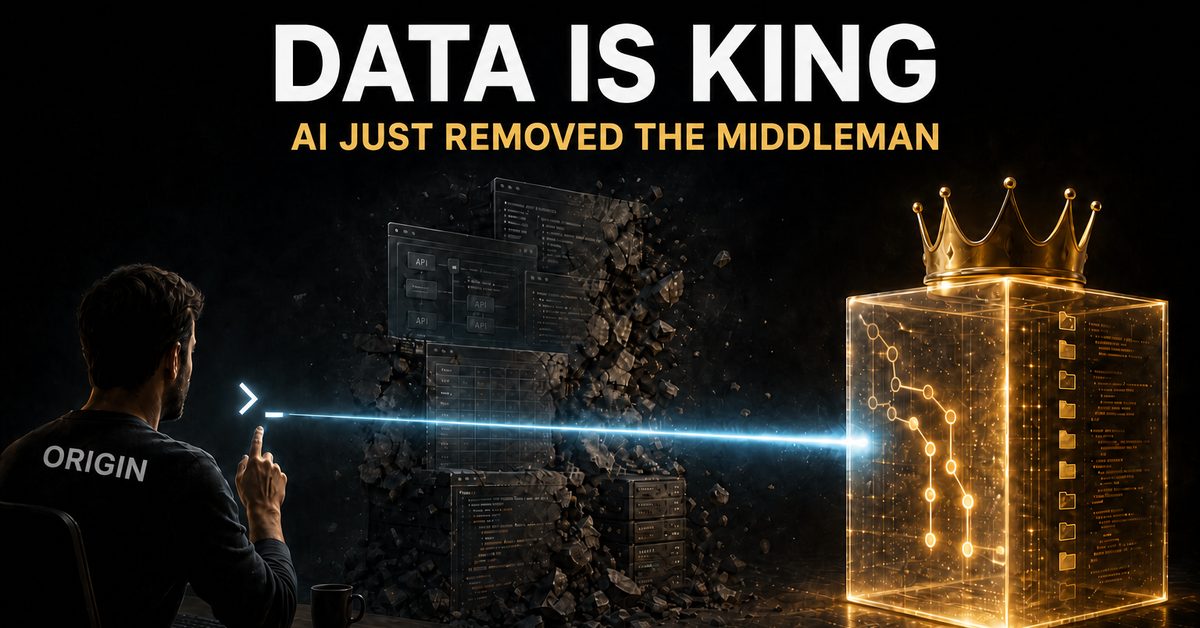
For years we have said data is king, without fully appreciating what that meant.
Data by itself was hard to use. Engineers had to understand it, write queries, encode business logic, build APIs and interfaces, then deploy and maintain the result. The application sat in the middle as interpreter. There was significant machinery between having data and getting value from it.
AI is collapsing that machinery.
Instead of developers anticipating every question and encoding every interaction, we can describe what we want, provide context, iterate, and spend tokens. The cost of turning data into useful information is falling, and strategic value is moving with it.
The data itself becomes king.
Origin Is a Signal
That is why Cursor’s Origin announcement caught my attention.
At first glance it looks like another GitHub, GitLab, or Bitbucket. That misses the point.
Cursor is an AI development company recognizing that its most important input is the code itself, plus the history, structure, reviews, decisions, tests, and context around it. If that intelligence depends on another company permanently providing access, an important part of your future belongs to somebody else. APIs, pricing, permissions, and terms can change. The provider can ship a competing product.
I have lived through that.
When Your Platform Becomes Your Competitor
Years ago I worked at a startup whose product depended on Facebook’s platform and APIs. That access made the business possible. Then Facebook changed the rules and built overlapping functionality of its own. The company providing the infrastructure became the competitor.
We did not control the platform, or our ability to reach the data the product depended on. When those conditions changed, so did the viability of the business.
That experience permanently changed how I think about platform dependencies. There is an enormous difference between having access to data and controlling your ability to access that data.
Reimagining the Software Development Lifecycle
By moving closer to the repository, Cursor is not merely getting better access to code. It can rethink the entire software development lifecycle around AI.
Today we insert AI into a lifecycle designed decades ago: source control, issues, pull requests, review, testing, security, CI/CD, and deployment. If the company building the AI environment also controls where the source and its context live, the repository can become persistent context for requirements, implementation, testing, review, security, deployment, and maintenance.
That is bigger than a better editor. It is a chance to own the lifecycle from the moment an idea becomes a requirement through the life of the software.
Your Source Is Your Data
That makes ownership of source more important, not less.
A repository is not merely files. It is years of intellectual property and organizational knowledge. History, reviews, architectural decisions, tests, security findings, and increasingly AI-generated context may become as valuable as the code itself.
I want companies building incredible applications around that information: better coding, review, security analysis, agents, and ways to modernize software. The distinction that matters is between applications operating on my data and applications controlling my data.
The enterprise should own its source and decide which systems operate against it. Ownership does not mean hosting every byte. It means control and portability. If another company can restrict your ability to access, move, interpret, or build upon your information, how much of it do you practically control?
This matters more as AI systems accumulate context around source. An organization can legally own its code while years of decisions, relationships, agent context, and development knowledge sit trapped in a proprietary platform. Legal ownership and practical ownership are not the same thing.
Follow the Data
I expect we will see much more of this. AI companies will move toward the data. Enterprises will need to be deliberate about portability and control.
The model I want is straightforward:
Companies own their data. Applications compete for the privilege of creating value from it.
AI makes applications easier to build, interfaces easier to replace, and information easier to consume. That does not make data less valuable. It makes it more valuable.
Data was always king. AI is simply making that impossible to ignore.